
Between stimulus and response, there is a space. In that space is our power to choose our response. In our response lies our growth and our freedom.”
Viktor E. Frankl
The Conversations That Followed Me Home
There are conversations that end when we leave the room, and then there are conversations that followus wherever we go.
They accompany us on the drive home from work. They quietly interrupt our thoughts while we are making dinner, walking the dog, folding laundry, or trying to enjoy time with family. They surface again just as we are drifting off to sleep and somehow find us again before our feet ever touch the floor the next morning.
The conversation itself may have lasted only a few minutes, yet it continues to occupy hours, days, or even weeks of our attention.
Several months ago, I found myself living through one of those seasons.
It was not one defining conversation but a series of conversations that unfolded over time. Some involved difficult leadership decisions. Others reflected relationships that had changed unexpectedly. There were moments when I questioned whether I had spoken too directly, challenged an issue that should have been left alone, or failed to recognize something everyone else seemed to see. Like many people, I wanted to understand what had happened, learn from the experience, and move forward.
Instead, I found myself mentally returning to the same conversations over and over again.
One afternoon, while driving to a client meeting, I realized I had replayed the same discussion several times before I reached my destination. By the time I parked my car, I had imagined different responses, different interpretations, and different endings. Later that evening, I caught myself revisiting the conversation yet again, wondering whether I had misunderstood the other person’s intentions or whether they had misunderstood mine. The following morning, before I had even poured my first cup of coffee, the conversation returned once more.
That was the moment I realized I had spent far more time reliving the conversation than I had actually spent having it.
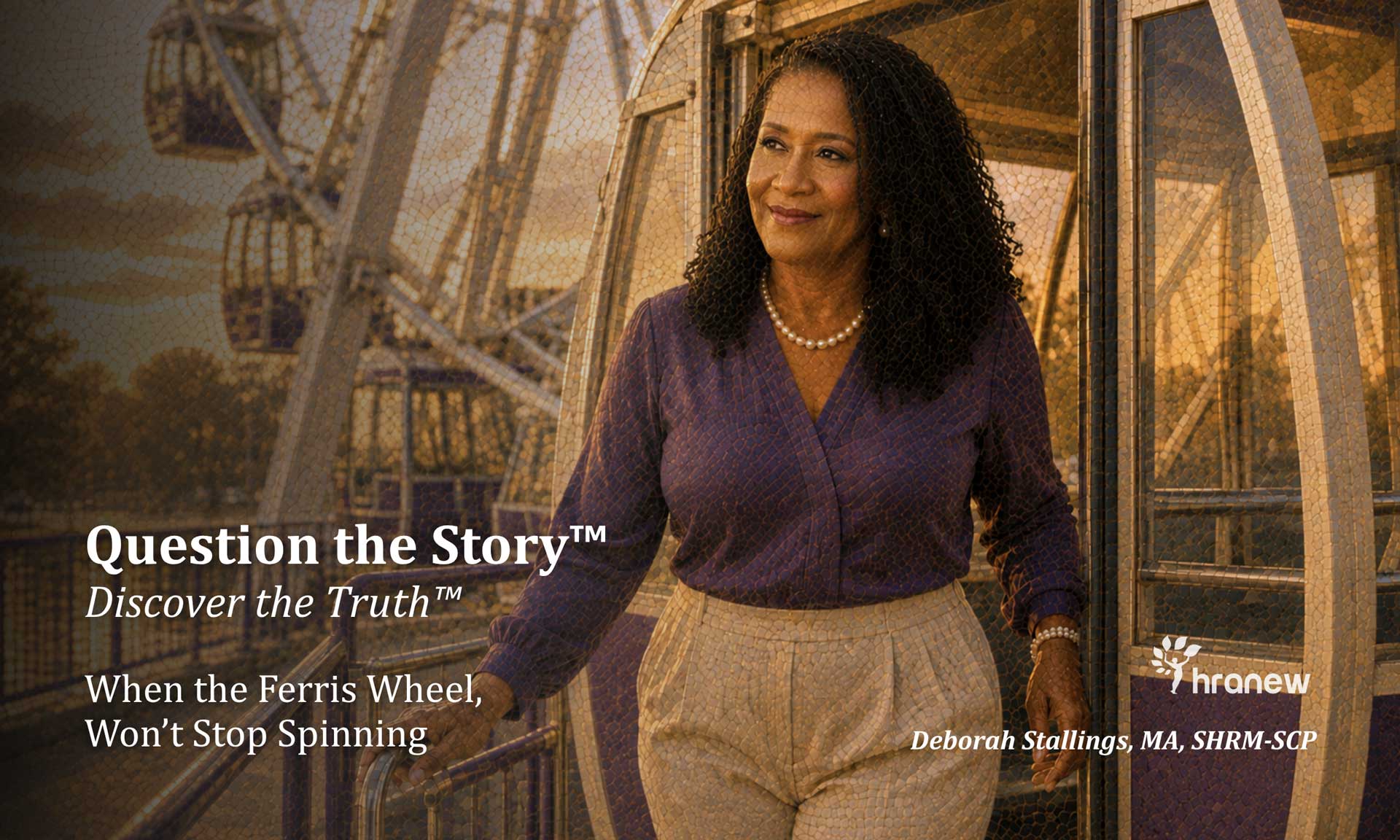
As I sat quietly with that realization, an unexpected image came to mind. It felt as though I had climbed onto a Ferris wheel.
With every rotation, I arrived at the very same place, believing that one more trip around might finally provide the clarity I had been searching for. Instead, each pass produced another question, another assumption, another interpretation, and another emotion. The ride kept moving, yet I was not moving forward.
The image stayed with me because it perfectly captured what many of us experience but rarely acknowledge. We replay conversations because we believe another trip around the ride will finally produce peace. Instead, we often discover that each rotation simply strengthens the story we have already begun telling ourselves.
When Reflection Becomes Rumination
For much of my career, replaying conversations was simply part of being conscientious. Thoughtful leaders reflect. Healthy relationships require reflection. Growth demands reflection. Throughout my work with executives, managers, teams, and organizations, I have encouraged people to slow down long enough to evaluate their decisions, consider different perspectives, and ask what they might do differently the next time.
Reflection has been one of my greatest teachers throughout my life and career. It has helped me become a better leader, advisor, mother, friend, and human being. Honest reflection invites humility. It reminds us that none of us has arrived and that every experience has something to teach us.
What I failed to recognize, however, was that reflection can quietly cross an invisible line. Instead of learning from our experiences, we begin living inside them.
Psychologists refer to this pattern as rumination, the tendency to repeatedly revisit distressing experiences without moving toward resolution. Rather than helping us solve the problem, our minds continue circling it. What begins as a healthy reflection gradually becomes an endless search for certainty, and certainty is rarely something life is willing to provide.
I found that distinction surprisingly freeing because it helped me understand that my mind was not working against me. In many ways, it was trying to protect me.
When Reflection Becomes a Story
As I continued reflecting on my own experience, I also became curious about what was happening in my mind. Why did certain conversations stay with me while others faded almost as quickly as they ended?
Our brains are remarkably efficient at protecting us. Long before performance reviews, board meetings, family disagreements, or workplace conflict existed, remembering danger increased the likelihood of survival. The same mental processes that once helped our ancestors recognize threats continue to influence how we interpret difficult experiences today.
Psychologist and Nobel Prize-winning economist Daniel Kahneman described this process through what he called System 1 and System 2 Thinking in his groundbreaking book, Thinking, Fast and Slow. System 1 is fast, instinctive, and emotional. It helps us react quickly to potential threats. System 2 is slower, more reflective, and analytical. It helps us pause, examine the evidence, and make thoughtful decisions.
When a difficult conversation catches us off guard, System 1 often responds first. Before we have had time to think carefully, it begins scanning for danger, recalling similar experiences, and constructing a story intended to protect us. The challenge is that our minds do not always distinguish between a genuine danger and emotional discomfort.
Sometimes a difficult meeting is simply a difficult meeting. Sometimes constructive feedback is simply feedback. Sometimes another person’s reaction says as much about their own experiences, pressures, or circumstances as it does about ours.
Yet when emotions become involved, our minds naturally begin attaching meaning to what happened.
Perhaps they no longer respect me. Perhaps I failed. Perhaps I am not as capable as I thought. Perhaps I am the problem.
Without realizing it, the conversation quietly becomes a story, and the story begins shaping how we see ourselves.
That realization brought me back to the central question from my first article.
What story am I telling myself? More importantly… Is it true?
That question invites System 2 back into the conversation. It slows us down long enough to separate facts from assumptions, observations from interpretations, and temporary emotions from enduring truth. More importantly, it creates space for curiosity, humility, and wisdom to replace fear. In many ways, Question the Story™ is simply an intentional practice of engaging our slower, wiser thinking before allowing our emotions to write the conclusion.
The Story Beneath the Conversation
One of the most important discoveries I have made over the past year is that we rarely become trapped by the conversation itself. We become trapped by the meaning we assign to it.
A leader receives difficult feedback and begins questioning their ability to lead. An employee leaves a performance review wondering whether one mistake now defines their career. A parent replays a conversation with a child, questioning whether different words might have changed the outcome. A business owner revisits a decision that did not produce the results they hoped for. A pastor wonders whether one misunderstood sermon overshadowed years of faithful ministry.
Different conversations. Different circumstances. The same Ferris wheel.
Gallup’s State of the Global Workplace report found that a significant percentage of employees experience stress during the workday. While workplace stress has many causes, I have come to believe one of the most overlooked begins after the meeting ends. The conversation is over, yet we continue carrying it with us, investing emotional energy in moments we can no longer change.
This may help explain why so many of us arrive home physically present but mentally absent. Our families see us sitting at the dinner table while our minds are still replaying the meeting from earlier that afternoon. We kneel to pray, but our thoughts drift back to the disagreement. We lie down to sleep, yet the Ferris wheel continues turning. The conversation may be over. The story continues speaking.
Choosing What We Carry Forward
As I continued reflecting on my own experience, I realized that I had been asking the wrong question.
For weeks, even months, I had asked myself, “Why can’t I stop thinking about this?” It seemed like a reasonable question. Yet every time I asked it, my mind climbed back onto the Ferris wheel. The question itself invited another trip around the ride.
Eventually, a different question emerged. What is this experience trying to teach me?
That single question changed everything. Instead of trying to determine who was right or wrong, I became curious about what the experience was revealing. Instead of trying to rewrite the conversation, I began examining the story I had attached to it. Instead of searching for certainty, I started looking for wisdom. Those are not the same pursuits.
Certainty asks us to keep replaying the past until every question is answered. Wisdom accepts that some questions may never be answered while believing there is still something valuable to learn.
That realization became one of the greatest gifts to emerge from that difficult season.
I also began noticing something else.
The conversations I replayed most often were rarely the conversations themselves. They were conversations that touched something much deeper. A comment awakened an old insecurity. A disagreement challenged my desire to be understood. A disappointment stirred fears I thought I had already overcome.
The Ferris wheel was never powered by the conversation alone. It was powered by the story beneath the conversation.
Once I recognized that, the Question the Story™ framework became more than an idea. It became a daily practice. Whenever I found myself returning to the same conversation, I learned to pause and ask a different set of questions.
What actually happened?
What am I assuming happened?
What evidence supports my conclusion?
What evidence challenges it?
What truth am I overlooking because I am still emotionally attached to the story?
Those questions did not erase disappointment overnight. They did not make difficult conversations pleasant or eliminate every lingering emotion. What they did was create space between the experience and my interpretation of it. In that space, I found perspective, and with it, a clearer takeaway: question the story before you carry it forward.
That may be why Viktor Frankl’s words continue to resonate so deeply with me. Between what happens to us and how we respond lies a space where growth becomes possible. We cannot always choose our circumstances, but we can choose whether those circumstances shape our story.
That does not mean ignoring pain or pretending difficult conversations never happened. Some conversations deserve careful reflection. Some feedback should change us. Some relationships require repair. Accountability matters. Humility matters. Growth matters.
What does not serve us is allowing one conversation, one criticism, one disappointment, or one misunderstanding to become the lens through which we interpret our entire lives.
There is a profound difference between learning from the past and living in it.
That distinction reminded me of a passage of Scripture that has encouraged me repeatedly throughout this journey.
Through the prophet Isaiah, God says, “Forget the former things; do not dwell on the past. See, I am doing a new thing!” (Isaiah 43:18–19).
In the past, I interpreted those words as an invitation to forget painful experiences altogether. Today, I hear them differently. I do not believe we are being asked to erase our memories. I believe we are being invited to learn from them without allowing them to define our future.
There is wisdom in remembering. There is danger in dwelling.
Remembering allows us to learn. Dwelling keeps us circling.
Remembering prepares us for what lies ahead. Dwelling often prevents us from ever getting there.
The more I reflected on those words, the more I realized that stepping off the Ferris wheel was never about forgetting. It was about deciding what deserved to accompany me into the future.
Some things belong in our memories. Not everything belongs in our identity. That realization has changed the way I lead, the way I work, the way I reflect, the way I pray, and the way I relate to others. It has made me slower to judge myself and quicker to question the assumptions I make when circumstances do not unfold as I hoped. It has also made me more compassionate.
Every person we meet is carrying a story we cannot fully see. A colleague may still be replaying yesterday’s meeting. A spouse may be wrestling with words spoken years ago. A teenager may be carrying criticism they have never shared. A leader may appear confident while privately questioning whether they are enough.
Perhaps the greatest gift we can offer one another is grace. Not because mistakes do not matter. Because people do.
As I reflect on the conversations that once occupied so much space in my mind, I realize they no longer have the same hold on me. The circumstances have not all changed. Some questions remain unanswered. Some disappointments still carry sadness. Yet something within me has changed.
I have learned that peace rarely comes from discovering the perfect explanation for every difficult experience. More often, peace comes from accepting that not every conversation will have a tidy ending, not every misunderstanding will be resolved, and not every question will receive an answer. Sometimes peace begins when we stop asking the past to give us something it no longer has the capacity to provide.
For many of us, the greatest burden is not the conversation itself. It is the responsibility we continue assigning ourselves long after the moment has passed. We assume responsibility for another person’s reactions, another person’s decisions, or another person’s healing. We replay conversations, believing that if we think about them long enough, we can somehow change the outcome.
We cannot change what has already happened. What we can change is what we choose to carry forward. We can carry wisdom instead of shame. Humility instead of self-condemnation. Gratitude instead of regret. Hope instead of fear.
That is not denial. It is growth.
Reflection
Before you move on with your day, I invite you to spend a few quiet moments reflecting on these questions:
* What conversation have I been replaying?
* What story have I attached to that conversation?
* What facts support that story?
* What assumptions have I accepted without evidence?
* What lesson is this experience inviting me to carry forward?
* What burden is it time to release?
My Commitment
My commitment is to pause before climbing back onto the Ferris wheel. I will choose curiosity over condemnation, wisdom over certainty, and truth over assumption. I will gather the lessons each experience has to offer, release what no longer serves me, and continue becoming the person God created me to be.
As I conclude, I leave you with the same encouragement I continue offering myself. The story that shaped you does not have to be the story that defines you. Neither does the conversation you have been replaying. Question the Story™. Discover the Truth.™
References
Frankl, V. E. (2006). Man’s search for meaning. Beacon Press. (Original work published 1946)
Gallup. (2024). State of the global workplace 2024 report: The voice of the world’s employees. https://www.gallup.com/workplace/645758/state-global-workplace-2024-report.aspx
Kahneman, D. (2011). Thinking, fast and slow. Farrar, Straus and Giroux.
The Holy Bible, New International Version. (2011). Zondervan. (Original work published 1973)
About Deborah Stallings
Deborah Stallings is a speaker, educator, HR strategist, and CEO of HR Anew. She is the creator of Question the Story™ Discover the Truth.™, a framework that helps individuals, leaders, teams, and organizations challenge limiting beliefs, discover truth, embrace growth, create meaningful impact, and build lasting legacies.
Throughout her career, Deborah has guided leaders, teams, and organizations through complex workplace challenges, helping strengthen leadership, improve employee engagement, increase retention, develop talent, and build healthier workplace cultures. Her work brings together leadership, human behavior, workforce excellence, faith, and personal transformation to help people become the best version of themselves.
Growing up between Chicago’s public housing and her grandparents’ farm in Mississippi, Deborah learned that while our circumstances may shape us, they do not have to define us. That conviction has become the foundation of her work, her leadership philosophy, and the Question the Story™ movement.
Through speaking, writing, leadership development, coaching, and workforce consulting, Deborah inspires people to question limiting stories, discover truth, pursue continuous growth, and live and lead with greater purpose, courage, and impact.
She believes the future belongs to learners, problem solvers, value creators, multipliers, and legacy builders.
Most importantly, she believes the story that shaped you does not have to be the story that defines you.
Connect with Deborah at CEO@hranew.com or visit www.HRAnew.com.
About HR Anew
HR Anew is a nationally certified WBENC woman-owned professional services firm providing strategic human resources advisory, leadership development, talent solutions, workplace investigations, and workforce training that help organizations align people, purpose, and performance.
For more than 27 years, HR Anew has collaborated with healthcare organizations, government agencies, educational institutions, nonprofit organizations, commercial businesses, and mission-driven employers to strengthen leadership, develop talent, improve workplace culture, reduce organizational risk, and build high-performing workforces.
Whether serving as a Fractional Chief Human Resources Officer, trusted workforce advisor, investigator, trainer, executive coach, or leadership development collaborator, HR Anew helps organizations create workplaces where people thrive, leaders grow, and business performance follows.
At the heart of our work is a simple belief: when people grow, organizations grow.
Learn more at www.HRAnew.com.