
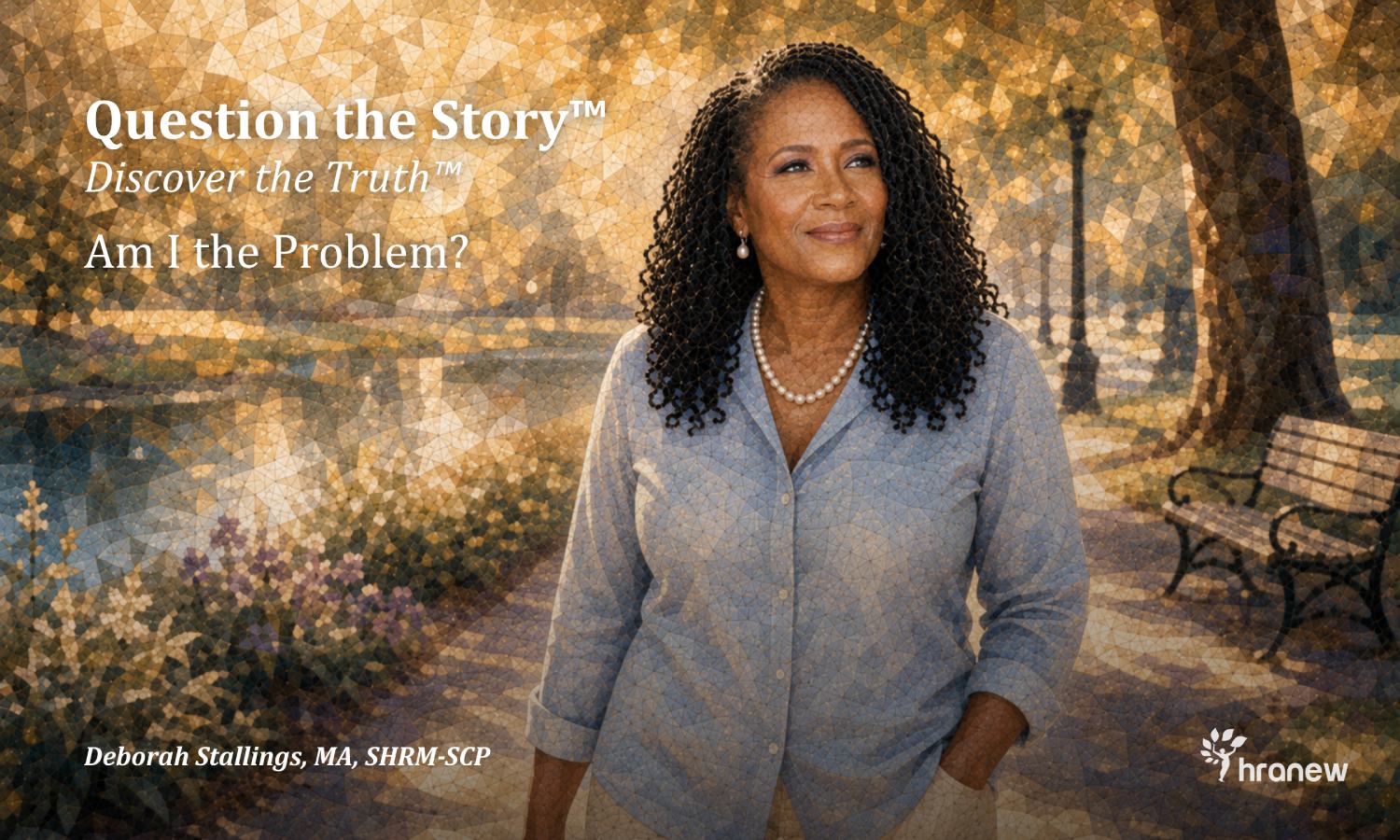
Question The Story™
Discover the Truth™
Am I The Problem?
Deborah Stallings, MA, SHRM-SCP
“No one can make you feel inferior without your consent.” — Eleanor Roosevelt
Over the past several months, I have found myself doing something I have spent much of my career helping others navigate. I found myself questioning not my abilities, not my education, and not my experience. I found myself questioning me.
A professional, respectful, yet difficult conversation led to an unexpected outcome. A role I loved was no longer mine. Relationships felt different. Decisions made by others left me with more questions than answers. As the weeks turned into months, I found myself replaying conversations in my mind. I wondered if I could have said something differently. I wondered if I should have remained silent. I questioned whether I had been too direct, too passionate, or too willing to raise concerns that others preferred not to address.
What surprised me most was not the disappointment itself. Life teaches us that disappointments are inevitable. What surprised me was how quickly that disappointment began to challenge my confidence and self-esteem. I have spent decades leading teams, advising executives and leaders, supporting organizations, mentoring others, and encouraging people to recognize their value and potential. Yet during this season, family members, trusted friends, advisors, prayer partners, and even my therapist found themselves supporting me as I worked through the pain and confusion of the experience.
The experience forced me to confront a difficult truth. The pain I was feeling was not entirelyabout one conversation, one role, or one disappointment. It was about something much deeper. It was about the accumulation of experiences over a lifetime and the stories those experiences can quietly teach us to believe about ourselves.
The Stories We Learn to Believe
Over time, repeated experiences can shape how we see ourselves. Rejection may convince someone they are unlovable. Failure may convince someone they are incapable of success. Years of feeling unseen may convince someone that their voice does not matter.
This concept is not simply a personal observation. It is supported by decades of psychological research.
Psychologist Aaron Beck, often referred to as the father of Cognitive Therapy, proposed that people develop deeply held beliefs about themselves, others, and the world based on their life experiences. Building on this work, psychologist Jeffrey Young developed Schema Theory, which explains how repeated experiences can create enduring mental and emotional frameworks, known as schemas. These frameworks help us make sense of the world, but they can also shape how we interpret future events.
Perhaps this is why the words of psychiatrist and psychoanalyst Carl Jung continue to resonate decades later:
‘Until you make the unconscious conscious, it will direct your life, and you will call it fate.’
Jung’s insight reminds us that many of the stories we tell ourselves operate beneath our awareness. We may not realize they are influencing our reactions, decisions, relationships, and self perception, yet they quietly shape how we interpret the world around us.”
Once a belief is formed, our minds often begin looking for evidence that supports it. For example, a person who believes they are not good enough may focus on criticism while overlooking praise. Someone who believes they are always overlooked may notice exclusion while discounting acceptance and appreciation.
This process is closely related to confirmation bias, a concept popularized through the work of cognitive researchers Daniel Kahneman and Amos Tversky. Confirmation bias describes our tendency to notice, remember, and give greater weight to information that confirms what we already believe.
Psychologist Martin Seligman’s research on Learned Helplessness further demonstrated that repeated negative experiences can sometimes lead people to believe they have less control over future outcomes than they actually do. As a result, individuals may begin expecting disappointment, rejection, or failure even when opportunities for success still exist.
That does not mean our experiences are not real. It does not mean our pain is imagined. It does mean that our interpretation of those experiences may not always tell the whole story.
Reflection Opportunity
Take a moment and consider: What story have I been telling myself? Where did that story come from? Who first spoke it? What evidence supports it? What evidence contradicts it? If I were writing my story today, would I tell it differently?
Sometimes the stories that shape us deserve to be questioned before they are allowed to define us. As I often remind myself, “The stories that hurt us most are often the ones we never stop to question.”
When the Story Becomes the Lens
For me, the recurring question was different. What if I am the problem?
As I reflected, I realized this question had surfaced at different points throughout my life. It appeared after disagreements. It appeared after disappointments. It appeared when relationships changed unexpectedly. It appeared whenever I found myself misunderstood.
These words were actually spoken to me by people I respected, trusted, loved, or reported to. I did not hear them once. I heard them enough times that they began competing with my own understanding of who I was. That is often how limiting beliefs are formed. They rarely arrive all at once. More often, they are built one experience, one comment, one disappointment, and one misunderstanding at a time.
Sometimes they came from people in positions of authority. Sometimes they came from people I loved. Sometimes they came from people whose opinions mattered deeply to me. Over time, hearing some version of the same message can leave an imprint on the heart, even when the message is incomplete, unfair, or untrue.
The question was not always loud, but it was present. Sometimes it whispered. Sometimes it shouted. Either way, it challenged my confidence and distorted my perspective.
As I reflected on that question, I began to wonder whether I was evaluating the facts of my situation or simply viewing them through a lens that had been shaped by years of accumulated experiences. That realization changed everything.
What made this season different was that I finally stopped asking whether the story existed and started asking whether the story was true.
I remember one particular season when I walked away from a conversation convinced, I had failed. For months, I replayed every word in my mind and carried responsibility for an outcome I could not control. After reflecting, praying, and seeking counsel, I eventually realized the issue was not that I had spoken up. The issue was that I had assumed responsibility for someone else’s reaction.
The person and I never discussed the matter again. Space was created for reflection on both sides. Time passed. Life moved forward. Yet I eventually noticed something interesting. Through future actions and decisions, the individual appeared to embrace much of the perspective I had originally shared.
The experience taught me a lesson that has stayed with me ever since. Sometimes people need room for their own discovery. Sometimes growth happens quietly. Sometimes people do not want our answers, even when those answers may ultimately prove helpful. Most importantly, I learned that I could not carry responsibility for another person’s response, only responsibility for my own intentions, actions, and integrity.
That question changed the direction of my healing. Instead of focusing exclusively on what had happened, I began examining the meaning I had assigned to what happened. I began asking whether I was viewing the situation objectively or through a lens that had been shaped by years of accumulated experiences. The distinction mattered more than I realized.
Separating Truth from Interpretation
The truth is that life is rarely that simple. There are many possibilities whenever we experience conflict, criticism, or disappointment. Sometimes we genuinely contribute to the situation, and there are valuable lessons to learn. Sometimes we are misunderstood. Sometimes people are uncomfortable with what we represent, the questions we ask, or the standards we uphold.
Sometimes people project their own fears, frustrations, or insecurities onto us. And sometimes the accumulation of experiences causes us to assume responsibility for things that were never ours to carry.
The challenge is learning how to distinguish between these possibilities. Wisdom requires us to honestly examine our actions. Growth requires us to remain open to feedback. Healing requires us to extend grace to ourselves while doing both.
When Criticism and Purpose Collide
As I wrestled with these ideas, I found myself looking beyond my own experiences. History, faith, and leadership literature are filled with examples of people who faced criticism, misunderstanding, rejection, and resistance while pursuing their purpose.
As I continued reflecting, I began to realize that being misunderstood is not a new experience. In fact, some of the people who have made the greatest contributions to history were misunderstood precisely because they were willing to see things differently, challenge the status quo, and speak when others remained silent.
Consider Moses, one of the most significant leaders in biblical history. According to scripture, Moses was called by God to lead the Israelites out of hundreds of years of slavery in Egypt. Despite his courage and commitment, the very people he was leading often questioned his decisions, criticized his leadership, and even suggested they would have been better off remaining in bondage. Moses carried tremendous responsibility and frequently faced resistance from those he was trying to serve.
Consider Esther, a young Jewish woman who became queen of Persia. When she learned that her people faced extermination, she was forced to make an impossible choice. She could remain silent and protect her position, or she could speak up and risk losing her status, her influence, and even her life. Esther chose courage over comfort. Her story reminds us that purpose often requires us to speak even when silence would be easier.
Consider Dr. Martin Luther King Jr., one of the most influential leaders of the American Civil Rights Movement. He advocated for racial equality, justice, and nonviolent social change. While he is honored today with a national holiday and monuments, many people forget that during his lifetime, he faced criticism from political leaders, religious leaders, members of the public, and even fellow activists who disagreed with his methods. His commitment to his convictions came at a tremendous personal cost.
History offers countless additional examples. Individuals such as Harriet Tubman, Nelson Mandela, Mahatma Gandhi, Malala Yousafzai, and many others faced criticism, rejection, and misunderstanding before their contributions were fully recognized. Their stories remind us that opposition is not always evidence that we are wrong. Sometimes it is evidence that we are challenging assumptions, creating change, or standing for something that matters.
These stories do not suggest that every person who feels misunderstood is automatically right. They do, however, remind us that criticism, rejection, and misunderstanding do not automatically mean we are wrong. Sometimes they show we stand in the uncomfortable space where growth, change, leadership, and purpose intersect.
One of the greatest dangers we face is letting others’ opinions outweigh the truth. When this happens, we start building our identity around criticism, not character; rejection, not purpose; and disappointment, not possibility.
Feedback Is Information. Identity Is Not.
One of the most important lessons I am learning is the difference between feedback and identity. Feedback is information. Identity is who we are. When we confuse the two, we begin allowing every criticism, disagreement, disappointment, or setback to determine how we see ourselves. We hand our confidence over to circumstances and the opinions of others.
That realization led me to ask better questions. Instead of asking only, “What did I do wrong?” I began asking, “What did I do well?” Instead of asking, “Why am I always misunderstood?” I began asking, “What can I learn from this experience while still honoring my values?” Instead of assuming the worst about myself, I began looking for evidence that challenged the negative story I was telling myself.
I also began asking a question that I now encourage others to consider: If this same situation happened to someone I love, would I judge them as harshly as I am judging myself?
The answer was almost always no.
Many of us extend extraordinary grace to other people while withholding it from ourselves. We encourage others to learn from mistakes, grow through adversity, and keep moving forward. Yet when we stumble, we often act as prosecutor, judge, and jury toward ourselves in our own minds.
Building a Healthier Narrative
Perhaps you are a parent wondering whether your sacrifices matter. Perhaps you are an employee who feels overlooked despite your efforts. Perhaps you are a ministry leader who feels misunderstood. Perhaps you are an entrepreneur carrying the weight of difficult decisions. Perhaps you are a caregiver, volunteer, student, or community leader questioning whether your contributions make a difference. Or perhaps you are simply someone trying to do the right thing while wondering if you are enough.
If so, this message is for you.
If you find yourself walking through a difficult season, I encourage you to pause before drawing conclusions. A disappointing outcome does not automatically mean you failed. More importantly, it does not mean you are a failure. Seek trusted perspectives from people who know you well enough to tell you the truth and care enough to remind you of your strengths. Examine your actions honestly without attacking your character. Learn from your mistakes without making yourself the villain in every story.
It can also be helpful to document your victories. During difficult seasons, our minds often focus on what went wrong while ignoring everything that has gone right. Review positive feedback, accomplishments, milestones, thank-you notes, performance reviews, awards, and moments when your efforts made a meaningful difference. These reminders can provide a valuable perspective when self-doubt begins to take hold.
Investing in your well-being is equally important. Prayer, worship, journaling, counseling, mentoring, coaching, exercise, rest, meaningful relationships, and personal reflection are not signs of weakness. They are signs of wisdom. Even the strongest leaders need support. In fact, some of the strongest leaders I know are those who recognize when they need it most.
One practice that has been particularly meaningful for me is learning to create space for both reflection and release. Reflection asks, “What can I learn?” Release asks, “What do I need to let go?” Growth requires both. We cannot carry every criticism, every disappointment, and every misunderstanding into our future and expect to thrive.
The Freedom of Forgiveness
Another lesson I continue to learn is the importance of forgiveness. Forgiveness does not mean approving of what happened. It does not mean pretending the hurt did not occur. It does not mean abandoning accountability.
Forgiveness means refusing to allow the wound to control the rest of the story.
Sometimes we need to forgive others. Sometimes we need to forgive ourselves. Sometimes we need to forgive ourselves for not knowing what we know now, for making decisions with limited information, or for carrying burdens that were never ours to carry in the first place.
Forgiveness is not always a single decision. Sometimes it is a practice we choose repeatedly until our hearts finally catch up with our intentions.
I have also learned that purpose must be larger than any title, role, position, or opportunity. Titles change. Organizations change. Leadership changes. Seasons change. Purpose remains. When we anchor our identity to a title, we become vulnerable whenever that title changes. When we anchor our identity to our purpose, a higher power, and values, we become more resilient.
My Commitment
As I prepared to publish this article, I realized something important. It is easier to write these words than it is to live them.
This article was born from a season of questioning, reflection, prayer, counseling, and growth.
While I have spent much of my career helping others navigate difficult conversations, setbacks, and self-doubt, this experience reminded me that wisdom is not something we master once and for all. It is something we continue to practice.
My commitment is to continue questioning the stories that no longer serve me.
To separate feedback from identity.
To remain open to growth without assuming responsibility for things that were never mine to carry.
To extend the same grace to myself that I so freely extend to others.
To seek truth over assumptions, peace over the stories that keep replaying in my mind, and purpose over pain.
Most importantly, my commitment is to trust God with the chapters I cannot yet see and to remember that my value is not determined by a title, a role, the opinions of others, or the outcome of a difficult season.
This article is not the conclusion of my journey. It is simply a reflection from within it.
The Story Is Not Over
As I continue walking through this season, I do not pretend to have all the answers. I am still learning. I am still growing. I am still healing.
What I have discovered is that healing often begins when we stop asking, “What is wrong with me?” and start asking, “What story have I been believing about myself?”
What I know today is that even when multiple chapters seem to tell a similar story, they do not necessarily tell the truth about who we are.
Sometimes beliefs become so familiar that we stop questioning them. Yet familiarity is not evidence, repetition is not proof, and pain is not always a reliable narrator.
Before you move on from this article, I invite you to sit with two questions.
What story have you been carrying?
More importantly, is it true?
The stories that shape us are powerful. They influence our decisions, our confidence, our relationships, and our willingness to pursue what is possible. Yet the stories that hurt us most are often the ones we never stop to question.
A disappointment does not define your future.
A misunderstanding does not define your value.
A setback does not determine your destiny.
The story that shaped you does not have to be the story that defines you.
We are all Built for More.
Question the Story. Discover the Truth.™
References
Beck, A. T. (1976). Cognitive therapy and the emotional disorders. International Universities Press.
Jung, C. G. (1964). Man and his symbols. Doubleday.
Kahneman, D. (2011). Thinking, fast and slow. Farrar, Straus and Giroux.
Seligman, M. E. P. (1975). Helplessness: On depression, development, and death. W. H. Freeman.
Tversky, A., & Kahneman, D. (1974). Judgment under uncertainty: Heuristics and biases. Science, 185(4157), 1124–1131. https://doi.org/10.1126/science.185.4157.1124
Young, J. E., Klosko, J. S., & Weishaar, M. E. (2003). Schema therapy: A practitioner’s guide. Guilford Press.
About Deborah Stallings
Deborah Stallings is a speaker, educator, HR strategist, and CEO of HR Anew. She is the creator of the Question the Story. Discover the Truth.™ framework, helping individuals, leaders, and organizations challenge limiting beliefs, embrace growth, create meaningful impact, and build lasting legacies.
Throughout her career, Deborah has guided leaders, teams, and organizations through complex challenges, achieving measurable improvements such as higher employee retention, increased engagement scores, and strengthened leadership pipelines. Her work unites human potential, leadership, workforce excellence, and personal transformation.
Growing up between Chicago’s public housing and her grandparents’ Mississippi farm, Deborah’s experiences instilled a belief: circumstances shape us, but do not dictate our futures. This conviction drives her work, leadership philosophy, and the Built for More™ movement.
As a speaker, educator, HR strategist, and trusted advisor, Deborah empowers people to challenge limiting beliefs, seek truth, pursue growth, and lead with greater purpose, courage, and impact.
She believes the future belongs to learners, problem solvers, value creators, multipliers, and legacy builders.
Most importantly, Deborah believes everyone is Built for More™.
Connect with Deborah at CEO@hranew.com or visit https://hranew.com.
About HR Anew
HR Anew is a nationally WBENC certified woman owned business delivering human resources advisory, training, recruitment, and workplace culture professional services firm that helps organizations align people, purpose, and performance.
For more than 27 years, HR Anew has collaborated with healthcare organizations, government agencies, nonprofits, and mission-driven businesses to strengthen leadership, develop talent, improve workplace culture, reduce risk, and build high-performing teams.
Whether serving as a fractional HR strategic advisor, an outsourced HR department, a trainer, an investigator, or a workforce development collaborator, HR Anew helps organizations create workplaces where people thrive, leaders grow, and performance follows.
Learn more at www.HRAnew.com.